Decision Trees
Decision Trees are a popular supervised machine learning algorithm used for both classification and regression tasks. They provide a tree-like model of decisions and their possible consequences, including outcomes, costs, and utility.
1. Introduction to Decision Trees
- Definition: A Decision Tree is a flowchart-like structure where an internal node represents a feature (attribute), the branch represents a decision rule, and each leaf node represents an outcome (class label or value).
- Use Cases: Used in various domains like finance, healthcare, marketing, and more for tasks such as classification, regression, and decision analysis.
Key Characteristics:
- Easy to interpret and visualize.
- Handles both numerical and categorical data.
- Requires little data preprocessing (no need for normalization or scaling).
- Prone to overfitting, especially with deep trees.
2. Structure of a Decision Tree
Components:
- Root Node: Represents the entire dataset and the first feature split.
- Internal Nodes: Represent splits based on a specific feature and a threshold or condition.
- Branches: Represent the outcome of a split decision.
- Leaf Nodes: Represent the final output (class label or regression value).
3. Algorithmic Steps
-
Select the Best Split: Choose the feature and threshold that best separates the data. Common criteria include:
- Gini Index (used in classification tasks)
- Information Gain / Entropy (used in classification tasks)
- Mean Squared Error (used in regression tasks)
-
Split the Dataset: Divide the dataset based on the selected feature and threshold.
-
Repeat: Recursively apply the splitting process to the subsets until a stopping condition is met (e.g., maximum depth or minimum samples per node).
-
Assign Leaf Values: Assign the class label (classification) or the mean value (regression) to the leaf nodes.
4. Splitting Criteria
(a) Gini Index
- Measures the impurity of a node.Lower values indicate better splits.
- Formula:
where (p_i) is the proportion of instances of class (i).
- A lower Gini Index indicates a better split.
(b) Entropy and Information Gain
- Entropy:
- Information Gain:
(c) Mean Squared Error (MSE) for Regression
- Measures the variance within a node.
- Formula:
where is the true value and is the mean value.
5. Advantages and Disadvantages
Advantages:
- Simple to understand and interpret.
- Handles both numerical and categorical data.
- Requires minimal data preprocessing.
- Can handle non-linear relationships.
Disadvantages:
- Prone to overfitting (solved using pruning or ensemble methods).
- Sensitive to small changes in data (can lead to different trees).
- Can be biased towards features with more levels or unique values.
6. Practical Techniques
(a) Pruning
- Reduces the size of a decision tree to avoid overfitting.
- Types:
- Pre-pruning: Stop growing the tree early (e.g., max depth, min samples per split).
- Post-pruning: Remove branches from a fully grown tree based on performance.
(b) Handling Missing Values
- Impute missing values or use substitute splits.
(c) Feature Importance
- Measures the contribution of each feature to the decision-making process.
- Computed based on the reduction in impurity.
7. Variants of Decision Trees
- Classification Trees: Used for categorical outcomes.
- Regression Trees: Used for continuous outcomes.
- CART (Classification and Regression Tree): A framework for building both types of trees.
8. Common Use Cases
- Credit Risk Analysis
- Disease Diagnosis
- Customer Segmentation
- Predicting House Prices
- Game Theory and Strategy Building
9. Advanced Topics
(a) Ensemble Methods
- Combine multiple decision trees to improve accuracy and robustness.
- Types:
- Random Forest: Combines multiple trees trained on random subsets of features and samples.
- Gradient Boosting: Builds trees sequentially, with each tree correcting errors of the previous ones.
(b) Hyperparameter Tuning
- Key hyperparameters:
- Max Depth
- Min Samples Split
- Min Samples Leaf
- Max Features
- Use Grid Search or Random Search for optimization.
8. Implementation in Python
Here’s a simple and clear example of a Decision Tree Classifier using a small, straightforward dataset to make it easy to understand:
Example: Predicting if a Person is Likely to Buy a Product
We will use a small dataset where the features are Age and Income, and the target is whether the person will buy the product (Yes or No).
from sklearn.tree import DecisionTreeClassifier, plot_tree
import pandas as pd
import matplotlib.pyplot as plt

# Example Dataset
data = {
    "Age": [25, 45, 35, 50, 23],
    "Income": [40000, 80000, 60000, 120000, 35000],
    "EMI": [1500, 2000, 1800, 2500, 1200],
    "Will_Buy": ["No", "no", "Yes", "Yes", "No"]
}

df = pd.DataFrame(data)

# Ensure target classes are consistent
df["Will_Buy"] = df["Will_Buy"].str.lower()

# Features (X) and Target (y)
X = df[["Age", "Income","EMI"]]
y = df["Will_Buy"]

# Decision Tree with Gini Index
clf = DecisionTreeClassifier(criterion="gini", max_depth=2, random_state=42)
clf.fit(X, y)

# Visualize the Decision Tree
plt.figure(figsize=(15, 15))
plot_tree(clf, filled=True, feature_names=["Age", "Income","EMI"], class_names=["No", "Yes"])
plt.show()
Explanation:
-
Dataset:
- Small dataset with just 5 examples for simplicity.
- Features:
Age,Income. - Target:
Will_Buy(YesorNo).
-
Model:
- A
DecisionTreeClassifierwithmax_depth=2is trained on the data to keep the tree simple.
- A
-
Visualization:
- The decision tree is plotted using
plot_treeto show how the splits are made.
- The decision tree is plotted using
-
Prediction:
- The model predicts for a new person (e.g., Age = 30, Income = 50000).
Output:
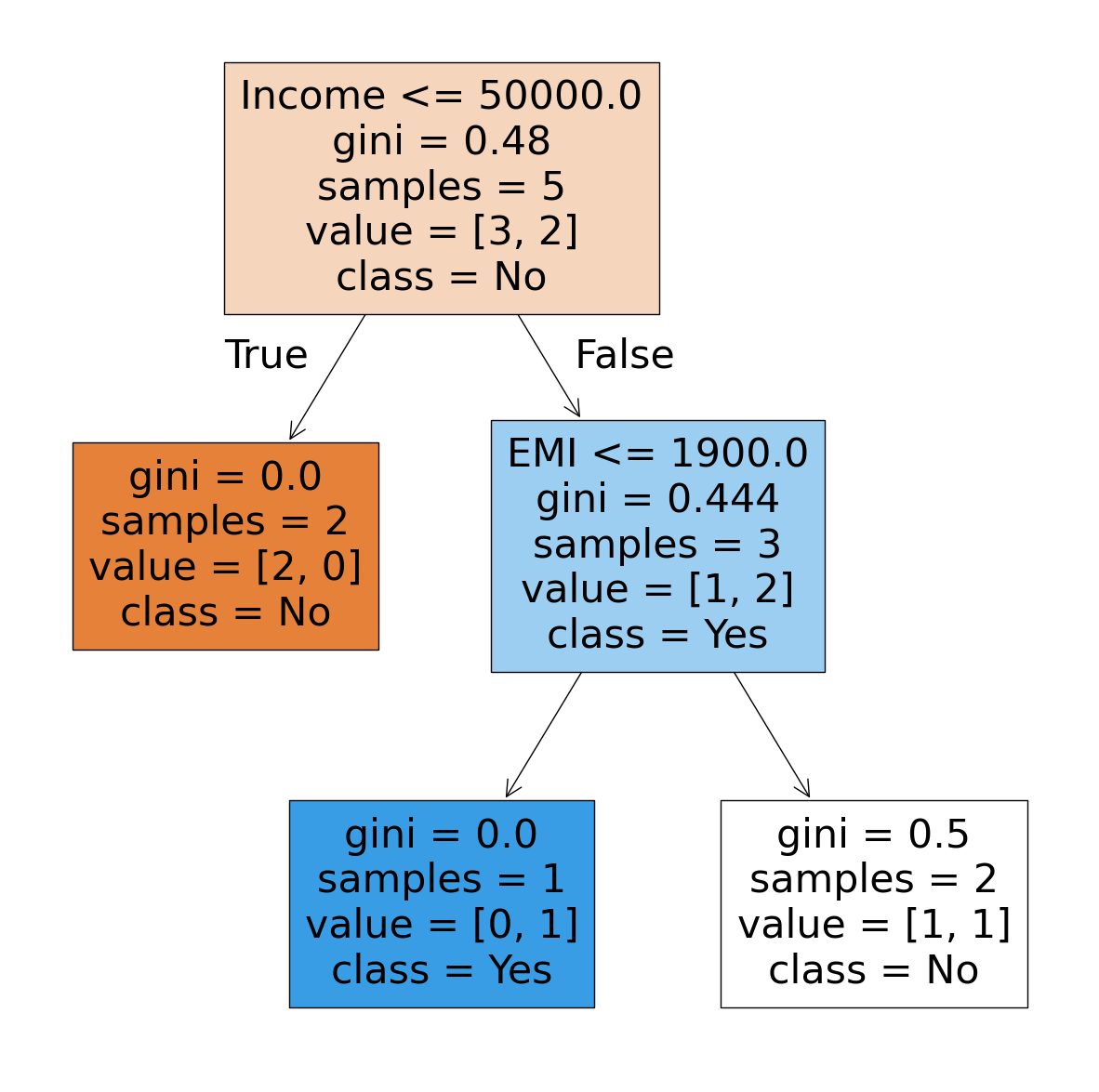
This example demonstrates how a decision tree splits the data based on features to make predictions, keeping the logic easy to follow.